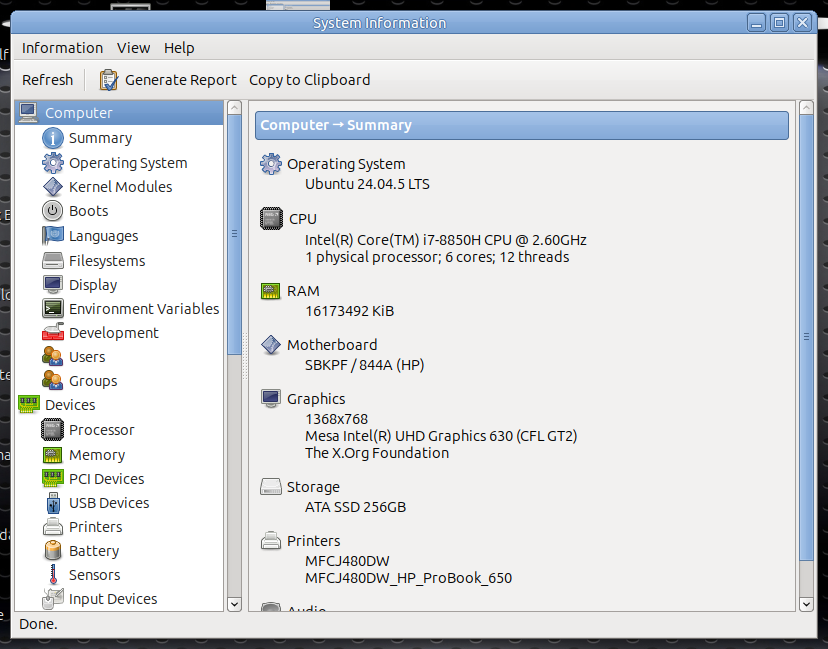
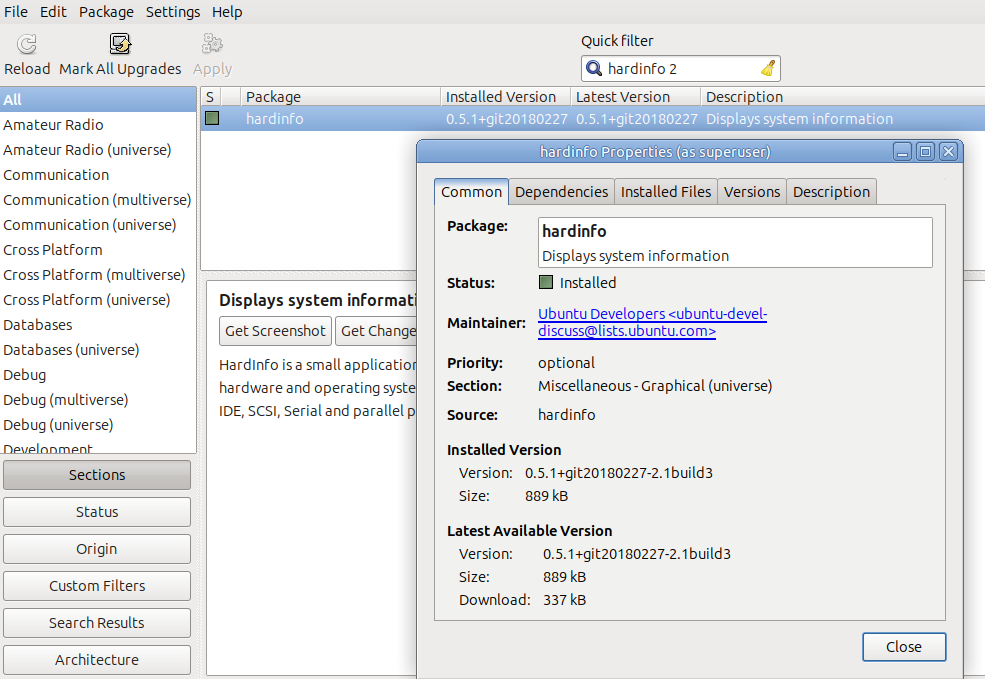
If you prefer a GUI to the terminal Hardinfo is a good choice. It will install as system profiler and benchmark. Hardinfo gives you a lot of good information about your system with a GUI.
HardInfo is a small application that displays information about your
hardware and operating system. Currently it knows about PCI, ISA PnP, USB,
IDE, SCSI, Serial and parallel port devices.
I prefer to stick with the official release in the Ubuntu Mater repository. I get the same responses for using Clementine, but I have never run into a problem because of using either.
@Jymm, the “problems” (which I have deliberately not characterised as such, due to the inherently nebulous definition of the word, in this context) are that its previous iteration shall lack the changes, that all of the commits applied in HI2’s codebase, introduce.
One could state the same about all previous iterations of all software, in most circumstances. However, consider the wider implications of everyone utilising myriad different versions of all software. It is much of what led to Linux OSes’ inability to compete with XNU and NT derivatives, until the widespread adoption of systemd.
Inherently, it fragments the maintenance burden.
An example of both a new feature, required for my hardware to be supported, and an example, that the work, required to support it, necessitates a sufficiently populous user-base, is:
Okay, but I am using the default version in the Ubuntu Mate repository. I am a casual user who genuinely doesn’t or can’t install other software. I don’t install tarballs without detailed step by step instructions I can just copy and paste and I often don’t understand and can’t find what to install on GitHub. So isn’t that up to the OS developer to update their repository? Also then I have to worry about separate updating unless it has a repository that I can add to Synaptic.
I’m old, started with Debian based OS’s and have no desire to change or learn another package manager. I I had to change it would be PC Linux because they ported Synaptic to it . I did look at Fedora once, but it didn’t have the software I wanted. That was more than a decade ago so has probably changed. So I will stay with Debian based as long as Debian is around.
@Jymm, if only GNOME and KDE had decided to not make their software managers so basic. If a multi-platform equivalent to Synaptic were available, I would utilise it, too. Strangely, despite PackageKit maintaining an abstraction layer for these package managers:
…each distribution re-invents their advanced graphical package management interfaces, so they never improve at a particularly impressive pace:
I lament the lack of decent Linux-based graphical package managers, considering that Windows now has such an incredible one, not least by comparison:
In the meantime, I utilise the CLI, because apt and dnf5 (and even zypper) are nigh identical in syntax. My sole gripe with them is how slow apt is, and its comparatively dysmal search results (because they are not tabular).