Servers aren’t what they used to be. If you’ve spun up a small VPS (Virtual Private Server) recently and felt underwhelmed by its snappiness, you’re not alone. A basic 1-core CPU with 1 GB RAM VPS was reasonably responsive a decade ago, yet today’s entry-level instances sometimes struggle under similar workloads. This article digs into… continue reading.
Interesting read, but my thoughts evolved as I read, and I wound up confused. Given the software problems (like OS requirements), the article suggests stripping things down helps, but near the end, the article pretty much says “StackLinux has your back” by mentioning policies that seem to make smart software choices irrelevant. Where’s the sweet spot for StackLinux customers with respect to installing does-more-and-uses-more software?
@Mat That’s a fair question, and I can see why it reads that way.
The intent isn’t that StackLinux makes software choices irrelevant. It’s that it removes a lot of the structural penalties that small VPSs suffer from today, so sensible software decisions actually pay off again.
A lean stack still matters. What StackLinux changes is the baseline: less contention, fewer throttles, more consistent CPU scheduling, and disk behavior that favors responsiveness instead of burst-heavy throughput. That’s the part users usually can’t control.
The “sweet spot” is still lean-by-design workloads: small web apps, databases, APIs, and services that care about latency and consistency. If someone installs increasingly heavy, memory-hungry software on a small instance, they’ll still hit limits. The difference is that those limits arrive because of the workload itself, not because the platform was already stacked against it.
In short, StackLinux doesn’t replace good judgment. It makes good judgment worth it again.
I dunno, YMMV, but my VPS are still pretty snappy. I’ve got a couple of them for $3.99 each a month, running Debian 12, with 1 CPU and 1 GB RAM. They’re running as MX hosts and openarena servers.
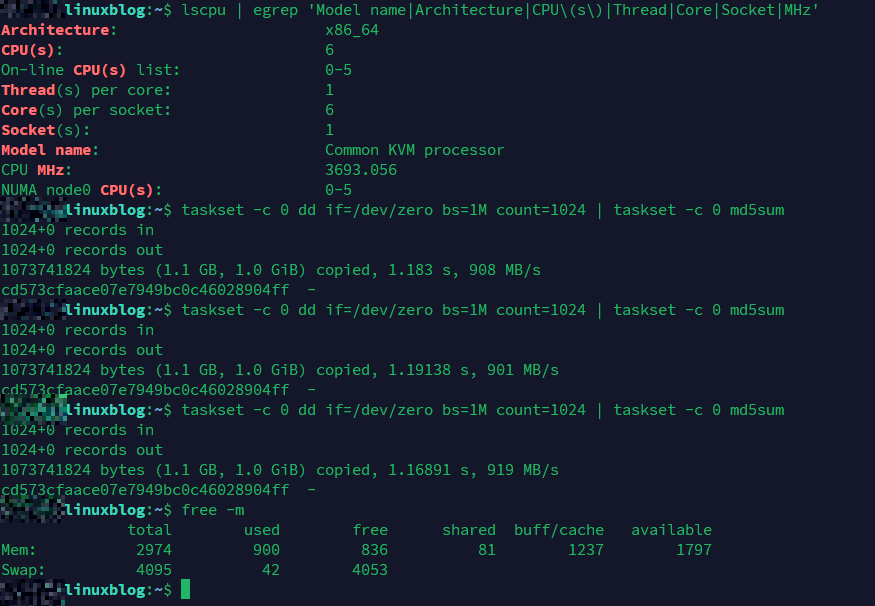
The command was adjusted to pin the test to one core. Single-core VMs are not offered due to inherent performance limitations.
The point isn’t that one is “better,” but that two small VPSs with similar specs on paper can feel very different depending on CPU generation, host load, and how cores are allocated.
Among other tweaks, StackLinux exposes full physical cores instead of SMT (Simultaneous Multithreading) threads because SMT shares execution resources and can introduce contention. Full cores provide more consistent performance for web and server workloads.
 Not bad.