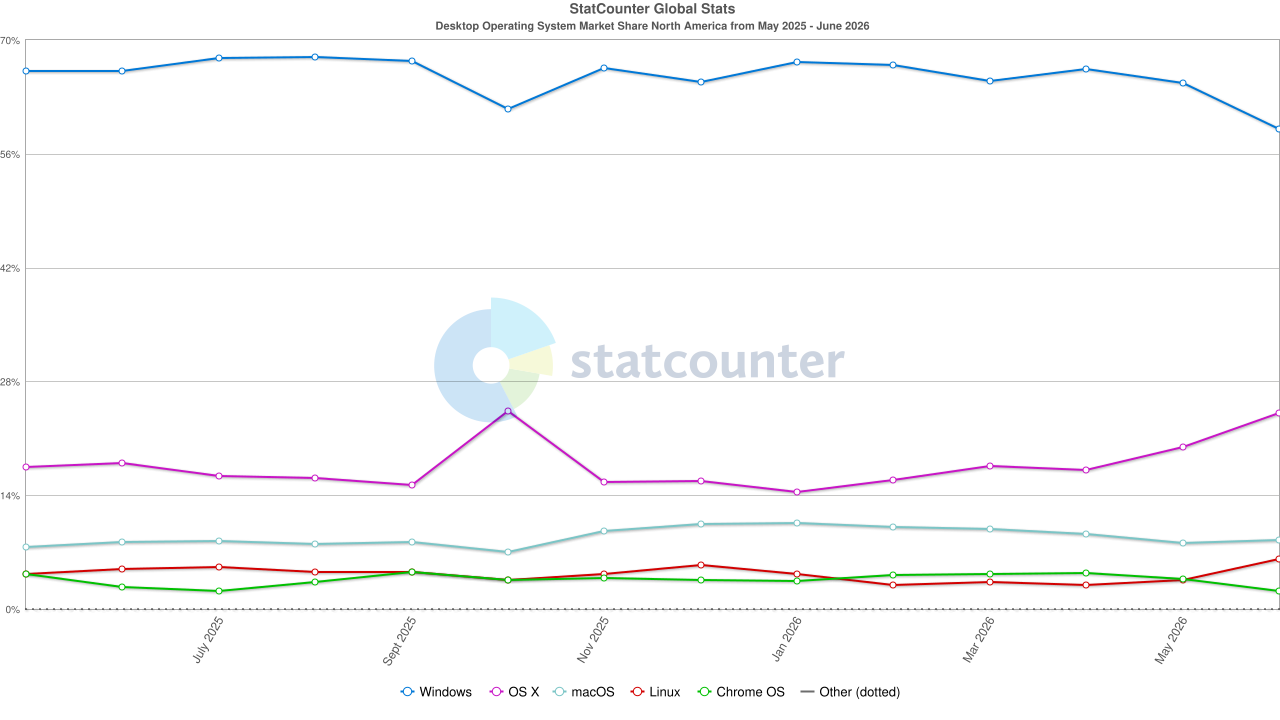
Linux has crossed a major milestone in North America, with the open-source operating system now accounting for 10.65% of desktop usage in the region, according to Statcounter’s latest figures for July 2026.
The result places Linux firmly in double-digit territory for the first time in Statcounter’s North American desktop operating system statistics.
For comparison, Statcounter recorded Linux at 5.52% in June 2026, so the share nearly doubled in one month. As expected, Windows remained the dominant desktop operating system, while Apple’s OS X and macOS categories continued to hold a substantial market share.
I always take Statcounter with a pinch of salt, I feel like that 10-11% would include a lot of bots, especially with AI crawlers nowadays. However, I suppose there is a trend upwards.
Because I use Linux on my work laptop, I do receive questions about what am I using. So I am an advocate, as to what is Linux and what can you really do with it.
Relying on StatCounter for actual Linux adoption metrics is fundamentally flawed for a few key reasons:
Tracker & Script Blocking: StatCounter depends on a JavaScript snippet executing in the visitor’s browser. Linux users heavily overlap with privacy-conscious demographics who run uBlock Origin, privacy-hardened browsers, or DNS-level blocklists. If the tracking script never fires, the visit is invisible.
Page Views vs. Installed Base: StatCounter measures raw web hits on partner sites, not unique hardware. Someone browsing 100 pages generates 100 counts; a user reading one article generates 1.
User-Agent Hardening: Many Linux distributions and privacy-focused setups spoof their User-Agent string to generic Windows/Firefox profiles to avoid browser fingerprinting.
StatCounter measures observable, unblocked web activity on specific tracking partners—it is not an operating system census.
I think the trend is completely off because you can’t rely on metrics from a counter—especially when it’s just tracking raw web hits and user-agent spoofing rather than actual installed hardware.
IF we include the heavily modified kernel that Google uses for Chrome OS, the Linux kernel is used as widely as any Chrome devices with the modified Linux kernel; that could impact the numbers if they’re actually counting these systems.
You’re right about that, but otherwise I have to wonder what’s with the wider Linux adoption? Could it actually be that the often hated marriage between Red Hat and IBM has led to more consumers actually using Linux in the work place, finding out that it’s pretty good software, then going out and trying it on their personal systems when they get home, or are the numbers inaccurate and a big mistake?
I’ve been for Linux throughout my career, and in my graduate Computer Information Systems studies I wrote paper after paper giving solid reasons why, on one hand, Linux wasn’t necessarily going to replace enterprise systems in the office on a massive scale or the comsumer desktop, spaces owned by IBM and Microsoft respectively. Nevertheless I felt that wireless, mobile computing scenarios, where nobody had established well known products.
Linux did gain a little traction but a few years later Google created a browser, followed by their own OS within less than a decade.
So to me it wasn’t necessarily a Linux DISTRIBUTION that changed the landscape, but the Linux KERNEL has affected Linux, Google, and Microsoft. Apple went a different way, but they have used a modified Berkeley Standard Distribution (BSD) as the basis for their entire Mac and iMac lineup for decades, so while it’s not Linux, conceptually it’s close - FREE Unix, and much of the Berkeley work came unto being while various “Fellow” researchers from AT&T’s Bell Laboratories went for further studies and teaching assignments, so even though all of these different variations are clearly NOT the SAME thing, they without a doubt had an impact on one another over the past four decades.