Is there anyone here who remembers Fido-net ? 

Have you heard about it or did you actually use it ?
If you did, do you still remember your node/point address ? 
Is there anyone here who remembers Fido-net ?
Have you heard about it or did you actually use it ?
If you did, do you still remember your node/point address ?
I missed the peak. Never used it.  Here’s the website: https://www.fidonet.org/
I think I might have missed something? 
Used FidoNet for years from home, and for sure remember it.
Used to connect and download various usenet etc group discussion logs, then read it afterwards offline, and if I actually wanted to reply I’d reconnect (when I could; auto-dialler may take awhile to get connected) and reply.
One of my favorite groups was a hard disk group; lots of talk about 5MB, 10MB, MFM vs RLL, and the newer 20MB drives… and soon larger [double-digit MB] drives…
I never tested the worth of purchasing a cheaper MFM drive and trying to convert it to RLL so as to get greater capacity; but for some reason I liked reading about the technical discussions about it. (Hard drives weren’t cheap; my first HDD cost me as much as my first motorcycle!)
Used it for years, before internet was a common thing.
I had a 28k8 modem in those days (later 56k6)
My favorite hangouts were ELECTRONICS.028 and BEER.028
Great, real great people I encountered there.
Someone even sent me by mail the schematics that I needed for a Hammond L112 tonewheel/tube organ that I was trying to get in working order.
The guy had a musical instrument business and loved to help out.
Sweet memories 
EDIT: I totally forgot to mention my fido address: 2:280/606.19
(I have to confess that I had to look that up)
Oh, and my computer ran MS-DOS at that time.
Editor: Golded, massively more advanced than any maileditor of even today
Mailer: Frontdoor
Oh man, memories are popping up left and right 
EDIT: i forgot I also used to hang around on the AUDIO message area
I started using it with an acoustic coupler; and my auto-dialer was relay(s) that shorted wires; the code in the [Z80] computer just output data at specific speeds to cause it to dial. In time I upgraded to a 1200/1200 modem which had dial capabilities; then PC/XT [clone] replaced the older Z80 (HDDs finally), modem upgraded to 14.4k, 36.6k, then 56.6k etc.
I remember most the Z80 days, or before I’d upgraded to a PC/XT compatible device; as modifying the phone so it could dial & handle the acoustic coupler took some effort, and I was wrapped that it worked.. Also downloads of various rooms traffic/data were being stored on floppy (768KB) required a tad more planning than later just saving it to a 20MB hdd to ensure it’d fit. It was slow, but the biggest hassle of the acoustic coupler was the need to ‘shake’ it every 15-20 mins to avoid errors [crystals in handset assumed occasional movement during operation; it never got that sitting in the coupler].
I have no idea what my fido address was. To me I still thought of it as a BBS system and still used it as such. The Fido-Net just meant I was able to download & reply to data from across the world (instead of only local BBS), and I knew the times I’d had to connect & send before data was transferred across the network, as missing those times could mean a reply takes another few hours before it reaches its destination. My memory is too vague as to the specifics.
My Z80 machine was a TRS-80 Model 4; running either TRSDOS or CP/M (dual booting even then!!); later PC/XT ran PC-DOS (IBM version of MS-DOS) sometimes with DoubleDos (or equivalent) so I could do something else as the room posts downloaded for later my reading.
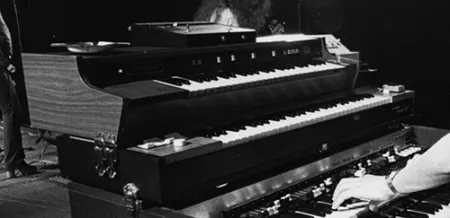
 at Hammond Organ; I only ever used Yamaha (three position) and never had access to drawbar/variable controls.
One bad day my hammond caught fire because the oil started slowly leaking from the tonewheel bearings right on top of the very hot rectifier and the valves of the main amplifier stage. Lots of big dense black smoke.
I sold the remnants, together with some other vintage gear I had, like an Solina/ARP String Ensemble , a Hohner Pianet.
Pretty much equal to the gear you see on this picture.

Before I forget: I bought shortly after that somewhat more lightweight stuff since the technology was finally on a level that it was adequate enough.
After a while on a Hammond XB2, I traded it for a Clavia Nord-Electro 2 which was specially designed for replicating the sounds of a Hammond C3 , a Yamaha CP70, a Fender Rhodes and a Hohner Clavinet. This together with a build in tube-like distortion, a ring-modulator, chorus, flanger and phase-shifters made it irresistable.
Think about it: 250 kg of vintage gear in a 9 kg package is much easier to haul around for gigs
I just found this:
Changelogs of all the nodes around the world, going back to the beginning.
You even can use it to trace back the fido address of de node based on BBS-name and/or just parts of the address you remember, even on sysop name 
It has been too long but I think
Ending up watching this video. Amazing!! 
Because of his strong accent he is often difficult to understand and he slips up here and there making it sometimes a bit confusing and tad more complex than it really was.
But man, that was so cool ! One thing I wonder is why lots of the pictures he shows are looking as if they were from the 1950s instead of the 1990s 
Nevertheless, man, what a good find !! And a trip down memory lane 
EDIT:
It is a pity that he skips over the fact that it was actually very easy to contact someone. Think about it: if you want to call someone you will need a telephone number. if you want to email someone, you need to have their email address. There is not really a difference.
It was just as convenient as e-mail, just with a latency up to a day (or up to 4 days internationally) instead of respectively seconds or minutes.
Also passing the mail was not manual work, most often it ran like a cron-like job.
Also, nodes did not “check” every mail. Points would contact their node if there was any problematic mail (just like flagging on discourse).
Privacy ? Just the same as on a discourse forum.
To be honest: echomail and netmail felt exactly like the discourse forum here (with the same good atmosphere.) I think with respect to that, that discourse has a lot in common with fidonet, with the difference that for discourse you have to be online.
He is off the mark w.r.t. commecialism. Even in the early years of internet, commercial mails and spam and the like were not done and it regulated itself because even the providers were vigilant… Until departments of justice and governments discovered internet and claimed rulership in their incredible incompetence, and in the wake of judges and lawyers came all the other criminals which quickly led to the mess we have today.
b.t.w. I don’t know of any discourse forum that is happy with soliciting emails and spam.
so that is also equal.
Better still: The Fidonet mail editors were way ahead of what we have now.
Quoted lines were preceded by the initials of the original senders just like in chat messages.
The quoted line were also differently colored in most maileditors (comparable to discorse, only a bit more compact). This means that many people could join an email conversation/discussion without getting it unreadable or confusing (not unlike a chat).
and this:
A: Because it is CONFUSING when having a delayed chat
Q: Why is top posting a bad thing ?
Yes, top posting was frowned upon, and often considered off limits.
EDIT2: He is also wrong about having to reupload if the connection was broken halfway a transmission. The protocol could just pick up where it left off and everything was compressed with z-modem protocol. Attachments were zipped and send along the mail instead of uncompressed and uuencoded inside the messagebody (and so smaller and faster).
My first reaction when I changed from FIDO to internet mail was “Oh my god what kind of backwards and archaic mess is this”. Fido mailing felt much more advanced.
Yes, I ran a FidoNet point for a few years in the late 80s, early 90s. I wish I could remember what my address was, but they say that your memory is the second thing to go*.
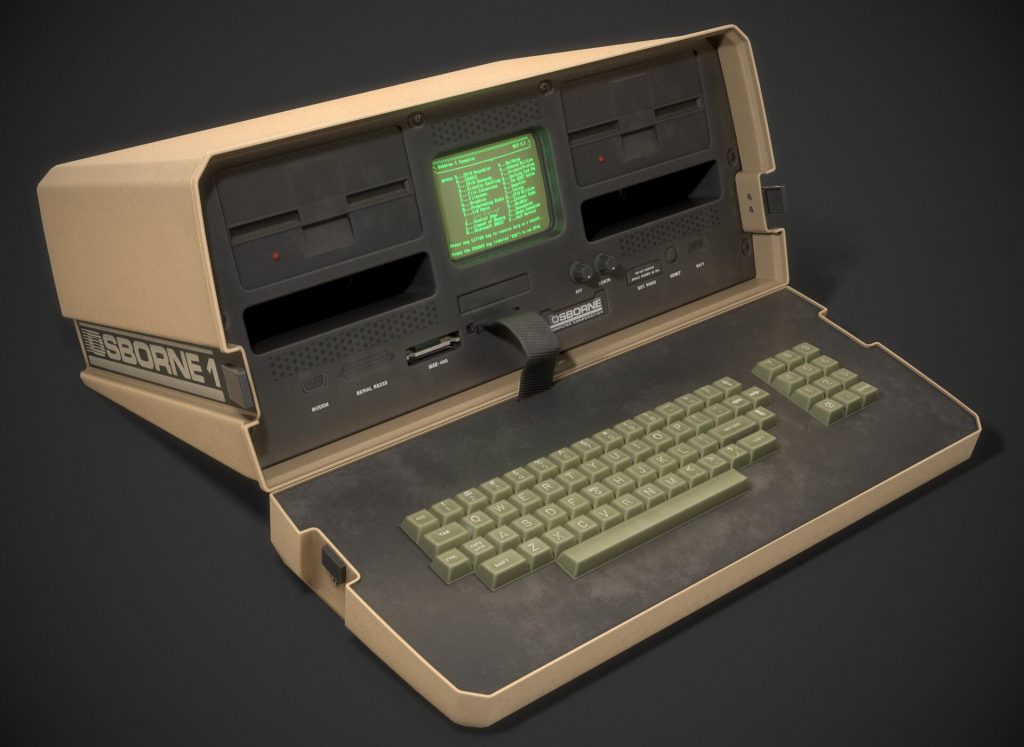
I ran on CP/M on an Osborne 1 (!), and then a DOS Zenith SuperSport. Modem speeds increased steadily in those years - 1200, 9600, 14400, 28 K, and finally 56 K, which you might be able to actually achieve with the right modem tweaks and directives.
Hey tkn, I frequented BEER :-), too! I was a mad home brewer back in the day…
(* I can’t remember the first thing.)
Did you ever brew a beer called “Zwaar Water” ?
Or did you brew a beer called “Stronk”
Or did you ever visited a meeting in “in de wildeman” ?
So Cool!
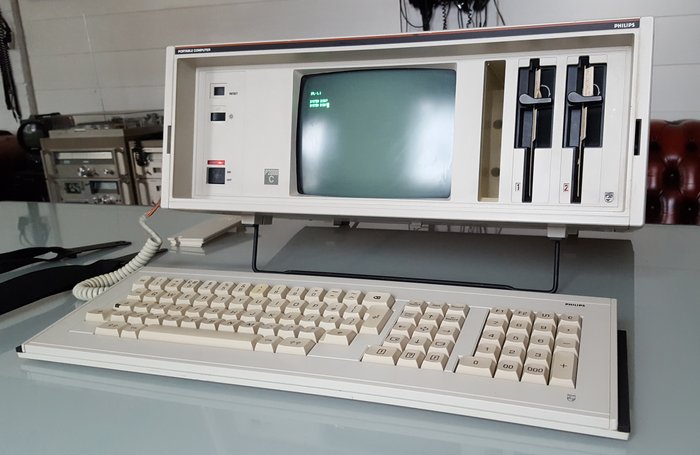
There was also Kaypro computer. I used it where I worked at the time.
I’m jealous Kaypro was the posterchild of the portable computers