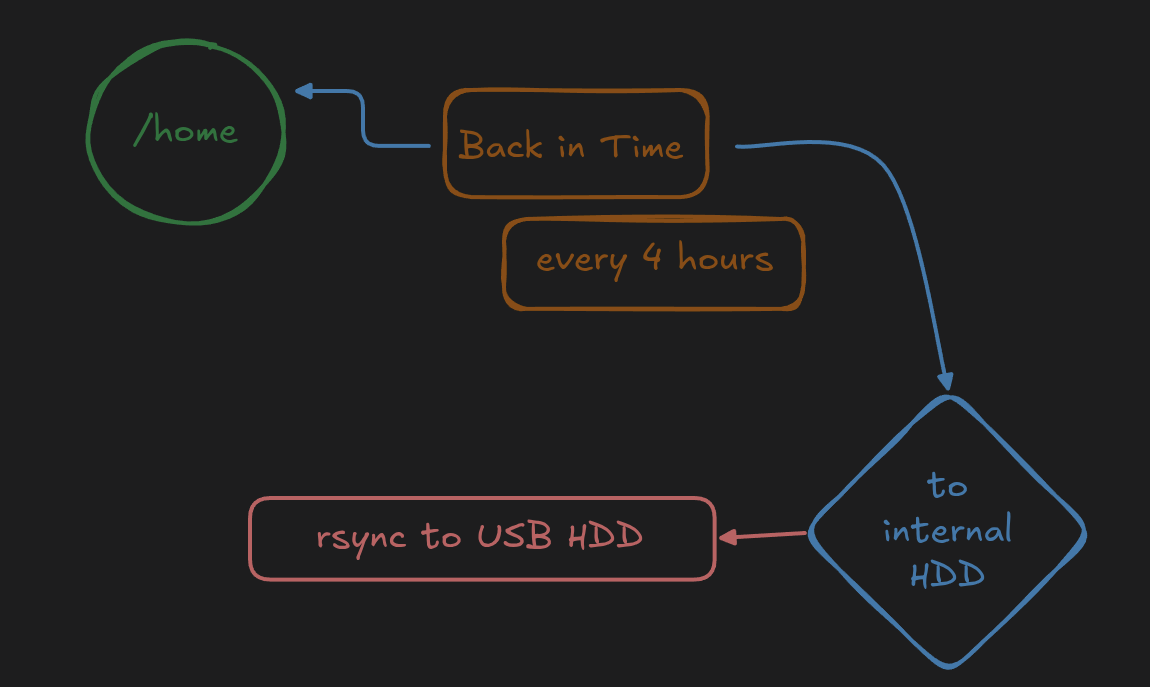
Ok, so most of us here probably run Linux on some machine. But what is your recommended backup solution? If there’s an HD crash or my laptop is stolen, I would like to restore all of my /home/user/ directory, including my dot/config files.
I’m curious what is your current solution for backing up your Linux laptop or workstation? External drive? NAS? Remote backup?
Lastly, what are my beginner to intermediate options for remote nightly backups of Linux desktop no matter the distro? (in case I don’t stick with one distro)
I’m sure you’ll get better answers from others, but here’s one that worked well long ago. I haven’t gotten to the point of needing to back up yet recently, so this is from decades old memory. Search “rsync time machine”, and you’ll see links like this and this that offer solutions/inspirations.
The idea is to set up a separate linux computer on your network that is your storage device. Then, on the linux computer you want to backup, run rsync in a shell script. Rsync is a file transfer command with an option to use hard links on the destination (storage) side of a backup scheme. This lets you make frequent backups (I have done every hour at times) that are very efficient space wise. You can get to the backup by browsing the file system on the storage system. To restore use similar rsync commands from the storage computer to the backed up computer.
Rsync is amazing, but its option count is immense, and may look intimidating. However, the options play well together, and you can pick and choose the ones you need. Rsync is the most robust transfer program I’ve used, and this backup scheme worked over poor/intermittent network connections.
I user overgrive and along with timeshift. Overgrive isn’t free but it’s also not costly.
timeshift - is used to backup your system and system files, not your home folder, and allows you to be able to roll back your system when something changes
For backing up your home dir, have a look at rsnapshot or overdrive if you upload to Google drive. Dropbox also has a Linux app for syncing the home directory.
My earlier rsync experience was with normal files. Does timeshift handle device files, or does one need to do a base OS install to put the timeshift backup on top of? I didn’t see mention of this on the timeshift page, but maybe I missed it.
I will have to look at our rsnapshot. I have my Docker folder in my home folder. So I have been looking for a way to back that up. It’s fairly large though about a few gigs. I will see if Google drive works first, if not I will try rsnapshot. Thanks for the recommendation.
It is CLI Only, but this reduces the dependencies we all love to hate. In fact the downloads available are a self contained executable for Linux, BSD or MacOS.
The basics are very simple and once set up (via cron, etc.) it is very easy to forget!
It can use multiple destinations, in addition to a local ‘cache’, on a multitude of platforms, including B2, which I use.
It has proven to be robust, reliable (even with an extremely poor internet connection) and relatively efficient. After the first backup the deltas are obviously much quicker.
For comparison, I have tried Restic, Rclone, Duplicat, Dupitii and a few others, but none are as easy to use or as reliable.
Given this is free and the developer is extremely approachable and amiable I can this of nothing better for protected valuable data.
The documentation at the above site is highly recommended and worth a read simply to understand some best practices.
I’m lazy, I have DejaDup going to my One Cloud account. I only backup the stuff in certain parts of my /Home/ dir the rest can just die until I do a fresh install. Most of the time I mis-configured something and needed to reinstall anyways.
I’m using paid cloud services. For pCloud I did a one-time payment some years ago, and my Nextcloud is hosted by Hetzner, a German hosting service.
I would be happy to host my own cloud on my NAS but I didn’t realize that. My NAS is too old, and I’m not sure how to get my own cloud secure. This is a project that I want to start in the next few years.

 Most of the time I mis-configured something and needed to reinstall anyways.

 and Kudos for not being a slave to paid cloud services like me.